7 Steps to Start Forex Trading with a Real Market Edge
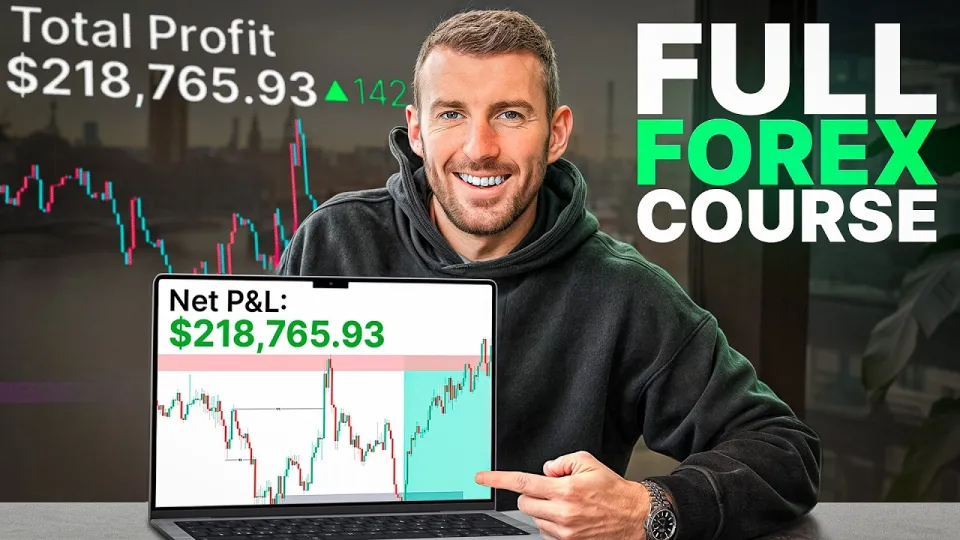
Video: Beginners Guide To Forex Trading In 2026 (+3 hours)
Want articles like this for your own video to promote it on YouTube and Google? Order them through the Telegram bot @sat_sit_bot. The bot writes and publishes the articles itself (with your YouTube video embedded) on popular topical websites (no ads). Free trial — 50 articles.
· based on the channel Matt Donlevey - Photon Trading
Key takeaways
- Forex is a decentralized over-the-counter market where currencies trade in pairs; daily volume exceeds $7 trillion.
- Retail traders access forex through brokers offering leverage, typically 30:1 in the EU and 50:1 in the US.
- Market microstructure—bid, ask, spread, and order book—explains why price moves, not geometric chart patterns.
- A complete trading plan includes entry criteria, risk per trade (often 1–2%), and a journal for review.
- Matt Donlevey's 3-hour beginner guide covers market dynamics, the Photon strategy, and common mistakes.
Forex trading is the act of speculating on the price movement of one currency against another, and beginners can start by learning market structure, risk management, and a repeatable strategy before risking real money. Unlike stock markets, forex has no central exchange; it is an over-the-counter network of banks, brokers, and electronic platforms. Matt Donlevey, creator of the Photon Trading channel, released a comprehensive beginner's guide that walks through everything from order books to trade journaling. You can get his free Photon Trading course and cheatsheets at photontradingfx.com/free-training.
What forex trading actually is and how it works
Forex trading involves buying and selling currency pairs, where the price reflects the exchange rate between two currencies. The most traded pair is EUR/USD, followed by USD/JPY and GBP/USD. Trading occurs in sessions: Sydney, Tokyo, London, and New York. The London session typically offers the highest liquidity, while the New York session overlaps with London for a few hours, creating the most active window. Retail traders do not buy physical currency; they speculate on price changes through a broker, using leverage to control larger positions with a smaller deposit. Leverage magnifies both profits and losses, so understanding margin requirements is essential.
Why market dynamics beat geometric patterns
Technical analysis often relies on chart patterns like triangles and head-and-shoulders, but these shapes do not explain why price moves. The real driver is market dynamics: the interaction of buyers and sellers, liquidity, and order flow. Matt Donlevey argues that a strategy must be built on true underlying market mechanics—how orders are matched, where liquidity sits, and how institutions execute large positions. This approach, often called market microstructure or auction market theory, focuses on the order book and the flow of transactions rather than static chart formations. By studying bid-ask spreads, order book depth, and liquidity pools, traders can identify areas where price is likely to react.
The Photon strategy: structure, liquidity, and timing
The Photon strategy is a systematic framework that combines market structure, premium and discount zones, supply and demand, and liquidity concepts. It starts with identifying the trend through higher highs and higher lows (or lower highs and lower lows) on multiple timeframes. Then, traders look for pullbacks into discount zones (below the midpoint of a swing) in an uptrend, or premium zones in a downtrend. Supply and demand zones—areas where institutional orders were previously placed—serve as entry points. Liquidity concepts, such as stop hunts and liquidity sweeps, help traders avoid being trapped by false breakouts. Finally, trade entries are refined using lower timeframes for precision, and trade management rules dictate partial profit-taking and stop-loss adjustments.
Money management and the three common mistakes
Money management is the foundation of long-term survival in forex. A common rule is to risk no more than 1–2% of account equity per trade. This means that even a string of losses will not wipe out the account. Matt Donlevey highlights three common mistakes: overleveraging, trading without a plan, and failing to journal trades. Overleveraging leads to emotional decisions and rapid drawdowns. Trading without a plan is gambling, not trading. And without a journal, traders cannot identify what works and what doesn't. A proper trade plan includes entry and exit criteria, risk parameters, and a routine for reviewing results. Backtesting the strategy on historical data builds confidence and highlights weaknesses before real money is at stake.
Choosing a broker, trading costs, and execution
Selecting a broker is a critical step for beginners. Regulation matters: in the US, brokers must be registered with the NFA and CFTC; in the EU, they fall under ESMA rules, which cap leverage at 30:1 for major pairs. Trading costs include spreads, commissions, and swap fees. Spread is the difference between bid and ask; tighter spreads are better for active trading. Commissions are common on ECN accounts, while swap fees apply to positions held overnight. Execution quality—speed and slippage—also affects profitability. Demo accounts allow beginners to test a broker's platform and execution without risk. Once comfortable, start with a small live account to experience real market conditions.
Trading psychology and building a journal habit
Psychology often determines whether a trader succeeds or fails. Even a profitable strategy can fail if fear and greed drive decisions. Matt Donlevey suggests mastering the strategy first, then focusing on psychology once an edge is established. Keeping a trade journal helps identify emotional patterns: do you exit winners too early? Do you move stop-losses? A journal should record the rationale for each trade, the emotions felt, and the outcome. Over time, patterns emerge, and traders can work on specific behavioral issues. Building discipline through a consistent routine—pre-market analysis, trade execution, and post-market review—creates a professional approach.
Useful links from the channel
- Free Photon Trading course and cheatsheets: https://www.photontradingfx.com/free-training?el=beginnersguide&htrafficsource=YT
- Photon Mentorship program: https://www.photontradingfx.com?el=beginnersguide&htrafficsource=yt
- Free Telegram channel with analysis and trade recaps: https://t.me/photontrading
- Instagram: https://www.instagram.com/photontrading/
Final thoughts
Starting in forex requires a structured approach: learn how the market actually operates, develop a strategy based on market dynamics, manage risk, and keep a journal. Matt Donlevey's 3-hour beginner guide on the Matt Donlevey - Photon Trading channel provides a free, comprehensive resource that covers these topics in depth. For those who want a structured starting point, the free Photon Trading course and cheatsheets are available at photontradingfx.com/free-training. Remember that trading carries risk, and most retail traders lose money. Treat it as a skill that takes time to develop.
Source: Beginners Guide To Forex Trading In 2026 (+3 hours) · Markdown version
Questions & answers
How much money do I need to start forex trading?
You can start with as little as $100 with a micro account, but to trade meaningfully and withstand drawdowns, a few thousand dollars is more realistic. Leverage allows you to control larger positions, but risk management is crucial to avoid rapid losses.
Is forex trading profitable for beginners?
Most beginners lose money initially due to lack of strategy and discipline. Profitability comes from a tested edge, strict risk management, and psychological control. It typically takes months of practice on a demo account before consistent results appear.
What is the best strategy for forex trading?
There is no single best strategy; it depends on your personality and schedule. However, strategies based on market structure, liquidity, and supply-demand zones—like the Photon strategy—have gained popularity for their logic-based approach.
How long does it take to learn forex trading?
Becoming consistently profitable can take 1–2 years of dedicated study and practice. Matt Donlevey's 3-hour guide provides a fast start, but real skill develops through backtesting, demo trading, and journaling over time.